

We didn’t evolve here
Review of The Hunter-Gathers Guide to the 21st-Century

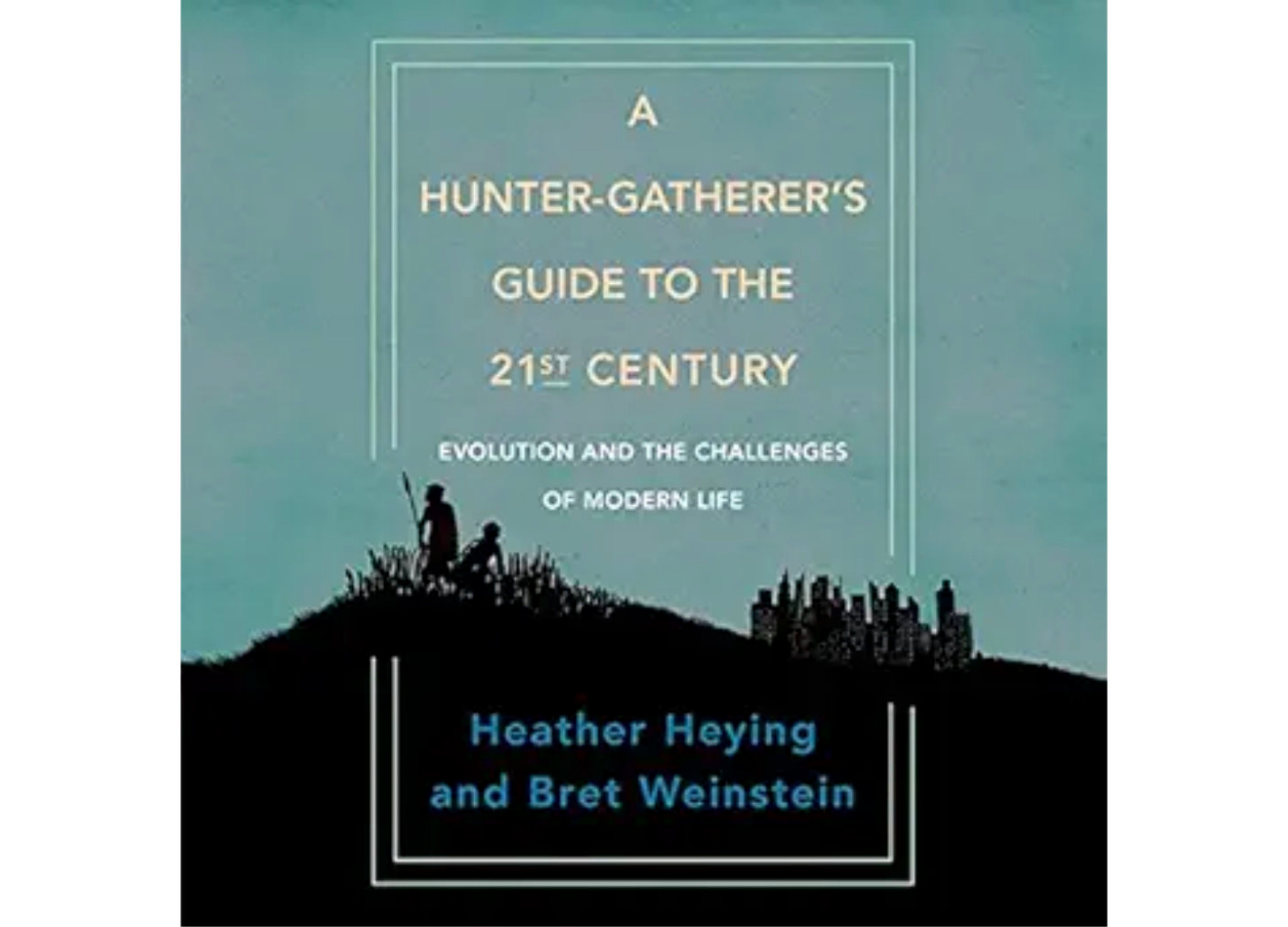
No, I don’t think we are aliens, and the authors of The Hunter-Gathers Guide to the 21st Century make no such claim. What Heather Heying and Bret Weinstein do say is that the Industrial Revolution has created an environment of hyper-novelty that disrupts our evolved biological processes. We’re living in a vastly different world than the environment in which we evolved and there’s a price for that.
Most of this book is insightful and useful and I recommend it. I am a big fan of the authors’ Darkhorse Podcast and greatly appreciate how they break down studies. But I got very stuck on the last chapter and wish they’d left it out. [I don’t know if the last chapter was there because the authors thought it was a good idea, or if the publisher demanded a certain word count.] I have the book on audio and always enjoy hearing the author read their own work, and Bret and Heather take turns reading.
The Guide is threaded through with stories of the authors’ adventures as they travel for both work and pleasure. Their experiences in vastly different cultures, and in dealing with the hazards of places without the safety rails of Western civilization are illustrative and evocative.
One of the first chapters is a detailed but very understandable description of how humans went from single-celled organisms to the complex thinking beings we are now. The point of this explanation was to demonstrate that we oversimplify our self-understanding at our own risk. Our biological systems - our bodies - are an intricate series of interactions that evolved over millions of years and we have no idea how badly we’re messing with them.
They talk about Chesterson’s Fence. This is the idea that barriers and limitations exist because all living things have to face tradeoffs when it comes to how we evolved. For example, an animal can’t be both very large and very fast. Energy is limited and and the larger an animal is, the more energy it takes to move. An elephant can’t be as fast as a cheetah. Another example is breeding strategies. A creature can produce a large volume of offspring and hope some survive - frogs - or invest heavily in a small number - humans. Both strategies work, but you can’t do both.
As the authors say, there are always tradeoffs.
If you really like this post but don’t want to subscribe, then maybe you could…
Bret and Heather don’t just talk about biology. They also talk about culture and how that makes humans successful as a species. When the environment is stable, we go about our lives, breeding and raising more humans. Skills that improve survival become habits that we don’t need to think about. On a group level habits become traditions. When conditions change, we must figure out how to adapt. We are master problem solvers but only in groups. Individuals come up with ideas to solve challenges but in order to execute them, we need to get others to pinpoint the problems, understand what needs doing, and cooperate.
The thing that makes humans unique from an evolutionary POV is that we do not have a niche - a place in the ecosystem outside of which we could not survive. Consciousness allows us to escape the niches that confine other species and live everywhere from the Arctic to the tropics, and deserts to jungles.
Once past the general discussion of biology and culture, they dive into the challenges we face as homo sapiens in a highly novel, technological world.
They begin with the reductionistic framework of Western medicine. While I already agreed with the point, it was refreshing to hear it from biologists. They also addressed epigenetics, which isn’t something I hear discussed often. Epigenetics is when genes get turned on or off depending on environmental conditions. From there they move on to what we eat and how we produce it. Industrial farming and much pre-packaged ‘food’ make use of chemicals that our bodies don’t recognize and don’t know what to do with. Next up was sleep, and all the ways that the modern world disrupts it.
Chapter seven, Sex and Gender, might have been my favorite [it was hard to choose] The authors gave a succinct description of why sex evolved in the first place and how deeply important respecting that distinction is to our development at all stages. Heather has opposed trans ideology from the start, and while I’ve heard quite a few men [like JBP] standing against it, I’ve appreciated hearing it from a woman.
The next few chapters [8 to 12] are about human development post-birth and also go into education. I knew there were some studies done by Sugata Mitra in India that demonstrated that children learn a great deal more on their own than we’ve given them credit for. However, I didn’t know that there are some cultures where teaching is actively avoided. As the authors point out, teaching is useful for things like reading, math, physics, and subjects like philosophy that require multiple POVs. However, humans need much less formal education than we’ve been led to believe.
At the end of chapters three through twelve, the authors offer multiple practical suggestions for countering the abnormal effects of the world we live in. Examples include:
Recognize the logic of trade-offs and how to work with them
Do not reduce food to its component parts
Resist pharmaceutical solutions to problems
Go to sleep early enough that you wake without artificial help
Avoid sex without commitment.
The book goes a little off the rails in the last chapter, making claims that were not addressed in previous chapters or defined. I don’t want my dislike of the last chapter to overshadow this review [my notes were extensive] so I’ll keep it brief. Chapter thirteen is a long-term attempt to come up with a way to ‘fix’ the problems we’ve been fermenting with such rapid growth. I was prepared to be engaged, but the ideas were underdeveloped and I had too many questions and counterarguments to get anything out of it.
They present the idea of ‘frontiers,’ without explaining where the idea came from, and propose the need for a stable economy controlled by those in power. That’s where they lost me. [Having spent ten years as a libertarian, I haven’t changed my mind about the trustworthiness of government officials.] They say that we are capable of driving ourselves extinct in pursuit of growth, yet they present no evidence. What evidence could be presented for this doomsday scenario beyond the actual extinction of the human race? Our brains are designed to be pessimistic, after all.
A few other issues I had [not comprehensive]
They say humans have an addiction to growth which is never brought up elsewhere in the book. There is no definition of either growth or addiction.
There was a nod to the value of religion in culture, illustrated by describing how the Maya built great religious monuments to keep good years from producing population explosions. However, later they denigrate religion by saying that we build extravagant monuments to fictional gods. [Bret is an atheist. I don’t know about Heather.]
They ignore the fact that regulated markets were what killed millions of people and created the most pollution.
They express concern about overpopulation without recognizing how much space the earth has open, or the benefits of more people.
The novelty we are now experiencing is highly disruptive and dangerous to our health and well-being. But when is life not dangerous? Even the authors say that nothing is wholly destructive. Our obsession with growth has improved the lives of poor people. People have air conditioners, clean heat, refrigeration, and the ability to communicate quickly over vast distances. These are things that weren’t available to the majority of humans until the Industrial Revolution.
Other than this last chapter, I give this book 4.5 out of 5 stars.
I’ve looked for and found guidance in making my life better. Here are some newsletters that might make yours better.
Andrew Lokenauth puts advice in easy-to-understand terms in his Money Mastery and Wealth Building newsletter.
Matt Leo talks about communication and people skills that apply to the home the board room.
Tim Ebl fights back against the steamroller of health issues with how to restore what we’ve lost to 21th-century food and habits.
Unskool offers insights and alternatives to the sucking pit of our education system
Bobby Dimitrov and Healthy Farming, Healthy Food share their journey on how to build a food production system that is better for humans and better for the planet.
Selina Rifkin, M.S. [Nutrition], LMT, has been to Hades in a handbasket. More than once. This has given her some opinions. Like most of her generation [X] she’s okay with snark. Most days she tries for good writing. But the snark, and side comments creep in. She lives with her husband, and is Mother of Cats; three boyz. Selina has written The Young Woman’s Goodlife Guide: Things I Wish I’d Known When I Was 20. Or… Learn From My Pain, and How to Train Your Cat: Using a Clicker and Leash to Keep Your Indoor Cat Happy and Healthy, the Goodlife Guide to Nutrition, and The Storytellers: a Journey of Discovery.
I wish more people would explore whether or not we did evolve here or whether our ancestors were in fact from other worlds with advanced technologies?