

Feminism needs focus
Don't get distracted by the Unhumans
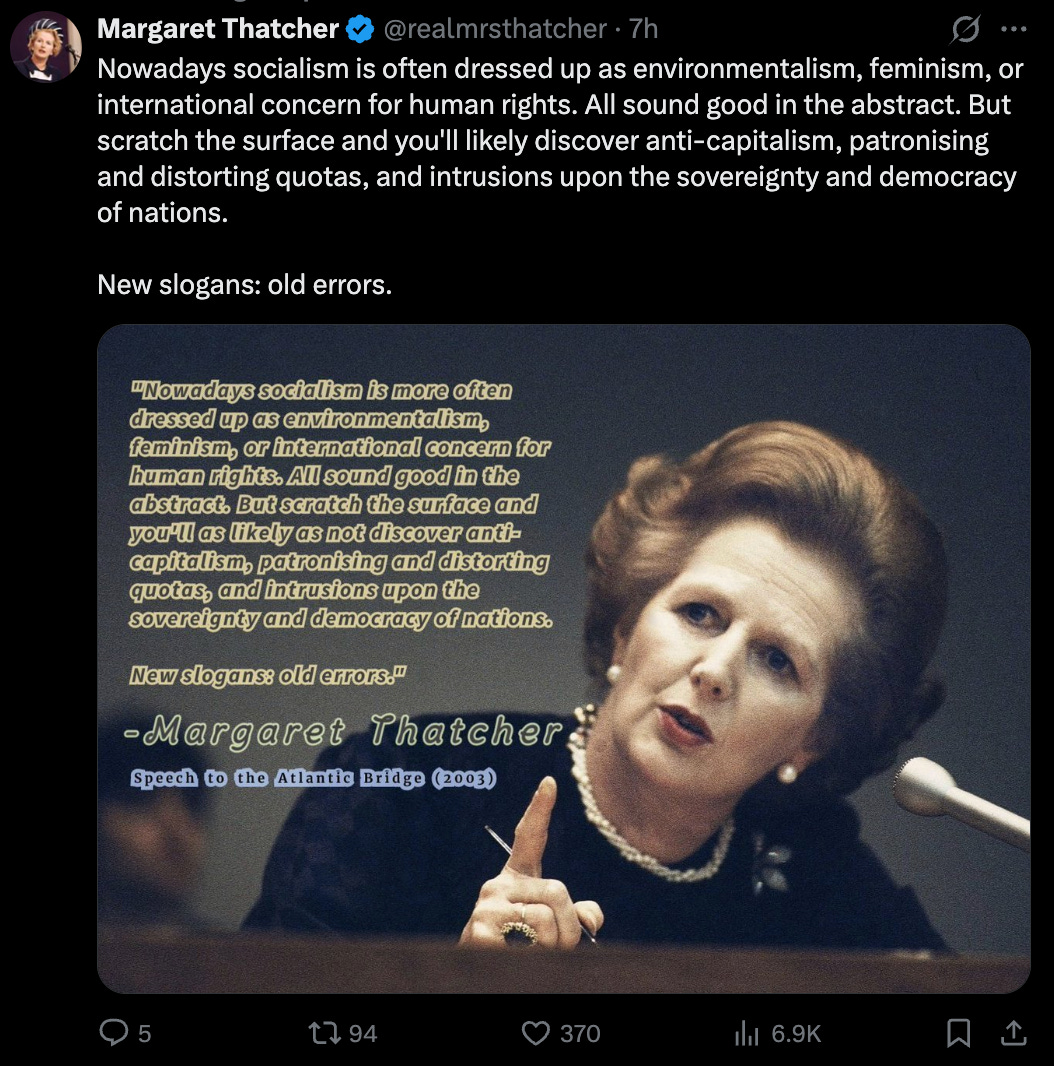
This is part 1 of a three part series inspired by this quote from Margaret Thatcher. We shouldn’t allow these things to be hijacked to mean something destructive. All of these things matter, and the way Unhumans* insert themselves into something good and turn it into something vile and destructive makes me angry.
But before I go there, we have to start with context. All three of the movements referenced by Thatcher had starting points in the industrial revolution. They couldn’t have existed without the changes brought about by the massive disruption of the first and second waves of the industrial revolution.
Therefore…
What is feminism?

This is from Grok [xAI] and is a compilation of the definitions in Britannica and Miriam-Webster.
A definition that seems reasonable enough until you get into how it’s expressed.
Feminism as a movement was first conceived by Mary Wollstonecraft, who was born on the eve of the first industrial revolution in 1759. She was born into a poor Irish family, the second of seven children. Her situation could best be described as dreadful. The family moved often to flee creditors, and her father was an alcoholic who’s moods ranged from joyful to vicious. He routinely beat the crap out of her mother and regularly raped her. He once hanged the family dog.
The backdrop to her youth was the French revolution, which sought to reshape society in a world where God was dead. It was the first major break with the sacred order that had organized Western society for centuries. Robespierre [yes, an Unhuman] killed priests and nuns [horribly] in what were called ‘republican baptisms’ and ‘republican weddings’, because they wouldn’t take the oath Robespierre demanded of all citizens that placed the state in the highest place.
As a teenager, Mary rebelled against her father’s behavior and set up shop outside her mother’s bedroom door where she tried to stop her father when he came home. This didn’t work and made her mother angry. She said that it inflamed Mary’s father even worse. Mary’s mother was the most submissive of creatures, and Mary resented both her father for his abuse and her mother for tolerating it.
I feel for Mary. As would any modern woman, even those advocating for tradwifedom. Not even the tradwives [and that’s a well I’m not going down right now] would advocate for a man to have this level of of control over a woman. Yet, modern feminists are dead silent on where the real abuse happens [link to Unveiled] which says just how much the movement has become ideological rather than principled.
Mary Wollstonecraft’s era was exemplified by removing taboos, such as those on monogamous marriage, and influenced by the utilitarian ethics of the Marquis DeSade. If God was dead, something had to fill the void, and humans went about attempting to do so with great enthusiasm. For someone like Mary, raised in the worst of family situations, it was an opportunity to escape. And escape she did.
After caring for her mother as she died, and then opening a school with her sisters and childhood friend. On her friend’s passing, she decided to try writing as a profession. This would be a completely new thing for women. Her fame came with the 1790 A Vindication of the Rights of Men. The pamphlet was one of the first responses to Edmund Burke’s condemnation of the French Revolution. It was was popular in both England and France, and gave her the opportunity to meet many intellectuals. She thrived in this environment.
In 1792 she followed up with A Vindication of the Rights of Women in which she advocated for equal education of boys and girls. She hoped that her ideas would make their way into the burgeoning French Republic. Her core thesis was that the current system was deliberately set up to keep women weak, prioritizing charm and beauty over reason. Lack of education was what stood in the way of women being true equal partners in their relationships.
“If woman be not prepared by education to become the companion of man, she will stop the progress of knowledge and virtue; for truth must be common to all.”
She also maintained that men - male writers in particular - had no business treating women as a separate, inferior species, rather than as full humans, and that men and women should pursue the same virtues. Women in professions would benefit the nation.
In the West, we have embraced the idea that men and women deserve equal education. Women now have equal responsibility in governance - ie., we can vote. The places where we’ve mucked this up and there’s backlash [tradwives, and people saying women shouldn’t have the vote] can be traced directly to Mary Wollstonecraft’s inability to choose a good partner, a gift she and the culture of the time passed to her daughter, Mary Shelley.
Mary Wollstonecraft met her first partner, an American, in France when she went there to observe the French revolution. He told the American consulate they were married, even though they weren’t, and after she borne him a child, he abandoned her and randomly showed back up in her life at his convenience, in between other lovers. Eventually, Mary returned to England, rather worn, and still very attached to him. She attempted suicide twice. In 1796 she met William Godwin a confirmed anarchist. Eventually Mary became pregnant, and in a great concession decided to marry. Both believed the possession of a woman in marriage was odious selfishness and that the family was the enemy of happiness because it enslaved male sexuality. [Note: male sexuality.] Mary died with the birth of her daughter in 1797. He daughter’s life was also a freaking nightmare of horrendous choices which I’ll spare you for the sake of brevity.
We might condemn Mary for her beliefs about marriage. But where, exactly, would she have learned what a GOOD relationship looked like? Her daughter, Mary Shelly had the same problem.
As a woman who took far too long to figure that out myself, I can’t judge her. She was a creature of her time and culture of upheaval in which she matured. She was the child of an abusive alcoholic in a culture that was disrupted enough to allow him to drag his family from place to place. She was clearly smart, and if she couldn’t find a good partner, she got some joy from the intellectual process.
However, her personal flaws were laid into feminism’s foundations. The idea that male supremacy was the core flaw of humanity, and thus culture was corrupt and should be torn down and rearranged was wrong. She extensively criticized the institutions of marriage and the church. [One might wonder how much Karl Marx was influenced by her, but I shall try not to get distracted.] Another of her ideas was that women were women first, mothers second, and that motherhood was what kept women from being full human beings. How much contempt must she have had for her own mother to declare such a thing? And how much self-hatred?
In contrast, Susan B Anthony [1820-1906] grew up in an intact Quaker household, where every child was seen as equal and filled with inner light. Her home was a hub for discussion with such people as Frederick Douglass and William Lloyd Garrison on the matter of abolition. She grew up seeing systemic inequalities as stemming from the flaws in human institutions rather than divine order. Unlike MW, she was raised in a home with Quaker virtues where alcohol was considered a failing and women were treated as having an equal voice, and educated.
Upon obtaining her degree, she found that she was paid substantially less than the men for the same teaching work. As a teacher in rural New York, she saw the results of alcoholism on women and children and became involved in the temperance movement. After a speech she gave on March 2, 1849 at a local event, the Sons of Temperance excluded her from all participation. This exclusion extended to the legislature ignoring the 28,000 signatures she collected from women and children begging them to create liquor-limiting legislation. It was this that led her to conviction that suffrage for women was necessary.
Like MW, Anthony, criticized Christian Churches. Her arguments were religiously ethical, and focused on there being no distinction between man and woman in the body of Christ. Anthony also viewed marriage as it was constituted in the 19th century as a form of legal subjugation because it didn’t allow women to own land or have control over their earnings. She also thought that marriage was what kept women from focusing on more ambitious goals, and she did no marry from principle.
Unlike MW, Anthony did not have children, from which we can infer that she did not have lovers [because reliable birth control didn’t exist yet]. Also unlike MW, Anthony had the possibility of changing laws, even without voting. Nor did she condemn marriage as an institution, only pointing out the need to further safeguard women and children against male violence.
Of these two visions, Anthony’s ideas are the least flawed and her primary focus was still protecting women and children. While MW wanted to tear the system down, Anthony wanted adjustments.
‘The least flawed’ is about the best we can do. To quote Bret Weinstein, ‘Welcome to complex systems.’ He says that we often confuse a complicated system with a complex one. Complicated is difficult, but understandable. Complex means we don’t even have the whole picture. Jordan Peterson says that humans do not understand ourselves. Psychology didn’t exist when MW was struggling to learn how to think in her complex and disrupted world. That’s the nature of ideas. We try them out. Some work. Most don’t. Ideas are cheap, and the embodied world is a hard taskmaster we are ill-served to ignore.
Anthony didn’t take up all of MW’s ideas. But later feminists did, and Anthony’s voice disappeared in the volume produced by later feminist like eugenicist Margaret Sanger, and Betty Friedan, a member of the Communist front organization, the Congress of American Women.
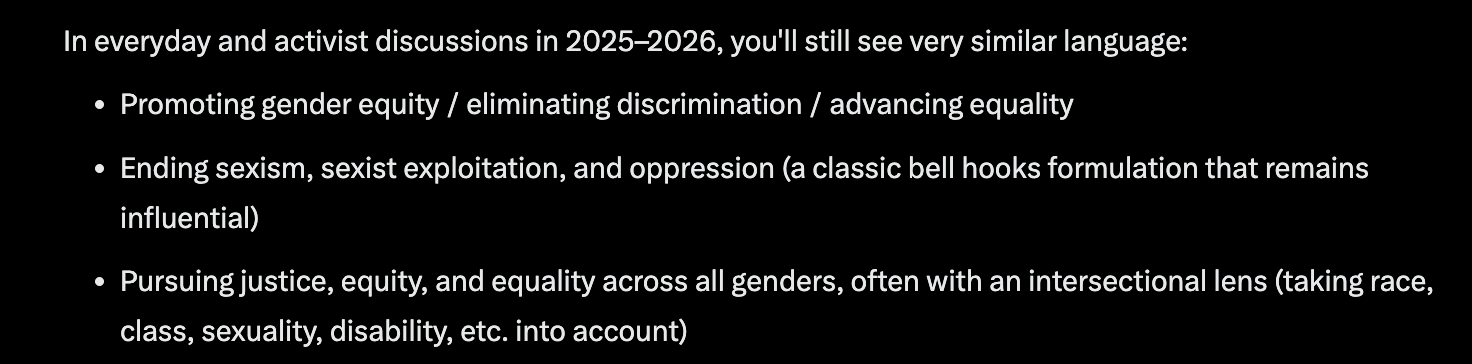
This is how you hack people’s passion and emotion: Twist the meaning of the word ‘equality’ into the word ‘equity’. Worse, take straight-forward ideas like ‘women should be educated, and ‘women should be able to own property and vote’, and dilute the goal by eliminating the end-point, [there is a whole essay here about definable, limited goals] and tossing in terms like ‘justice’ and ‘intersectionality’.
Words need to have meanings that we agree on because language is what defines and shapes humanity. Our ability to convey an idea to another human and let them absorb and critique it then toss it back is… magic [A spell]. As Jordan Peterson says, we examine and kill our ideas so they don’t have to kill us if they’re wrong. [paraphrase]
Some of the ideas in modern, third wave, communist-co-opted feminism will kill us. I’ve critiqued third-wave feminism here, here, here, and here. [There’s more, but listing 4 is plenty.] As women, we’ve achieved the goals of education, property ownership, and the vote. But humans are complex and women need to stop, and assess the effects of these wins before moving forward with goals like ‘equity.’ What neither MW nor Anthony understood was that women are not men-with-wombs. We have DNA-deep psychological differences that are critical to human evolution. Ideologues wish only to ignore human limits and complexity in favor of their vision. For them, nothing else matters. It is Unhuman.
Feminism has thus far only focused on increasing women’s rights. But rights come with responsibilities. We [women] need to stop and figure out what those are.
Or men will do it for us. And if our failings wreck civilization, we will deserve it.
*I’m taking the term Unhuman from Jack Posobiec and Joshua Lisec’s Unhumans: The Secret History of Communist Revolutions ‘Communism’ is just the current name for people missing the mark and reveling in the chaos they create.
Selina Rifkin, M.S. [Nutrition], LMT, has been to Hades in a handbasket. More than once. This has given her some opinions. Like most of her generation [X] she’s okay with snark. Most days she tries for good writing. But the snark, and side comments creep in. She lives with her husband, and is Mother of Cats; four boyz and one cranky gurl. Selina has written The Young Woman’s Goodlife Guide: Things I Wish I’d Known When I Was 20. Or… Learn From My Pain, and How to Train Your Cat: Using a Clicker and Leash to Keep Your Indoor Cat Happy and Healthy, and the Goodlife Guide to Nutrition.
This is late but thank you for your in-depth musings on this complex subject. In the end you summarized it well. Women are not men with wombs. Rights come along with responsibilities and perhaps in my mind women should focus on what their biological responsibilities are first and their rights are derived from that. Of course there will be a little energetic tussle to get there. Good job Selina!